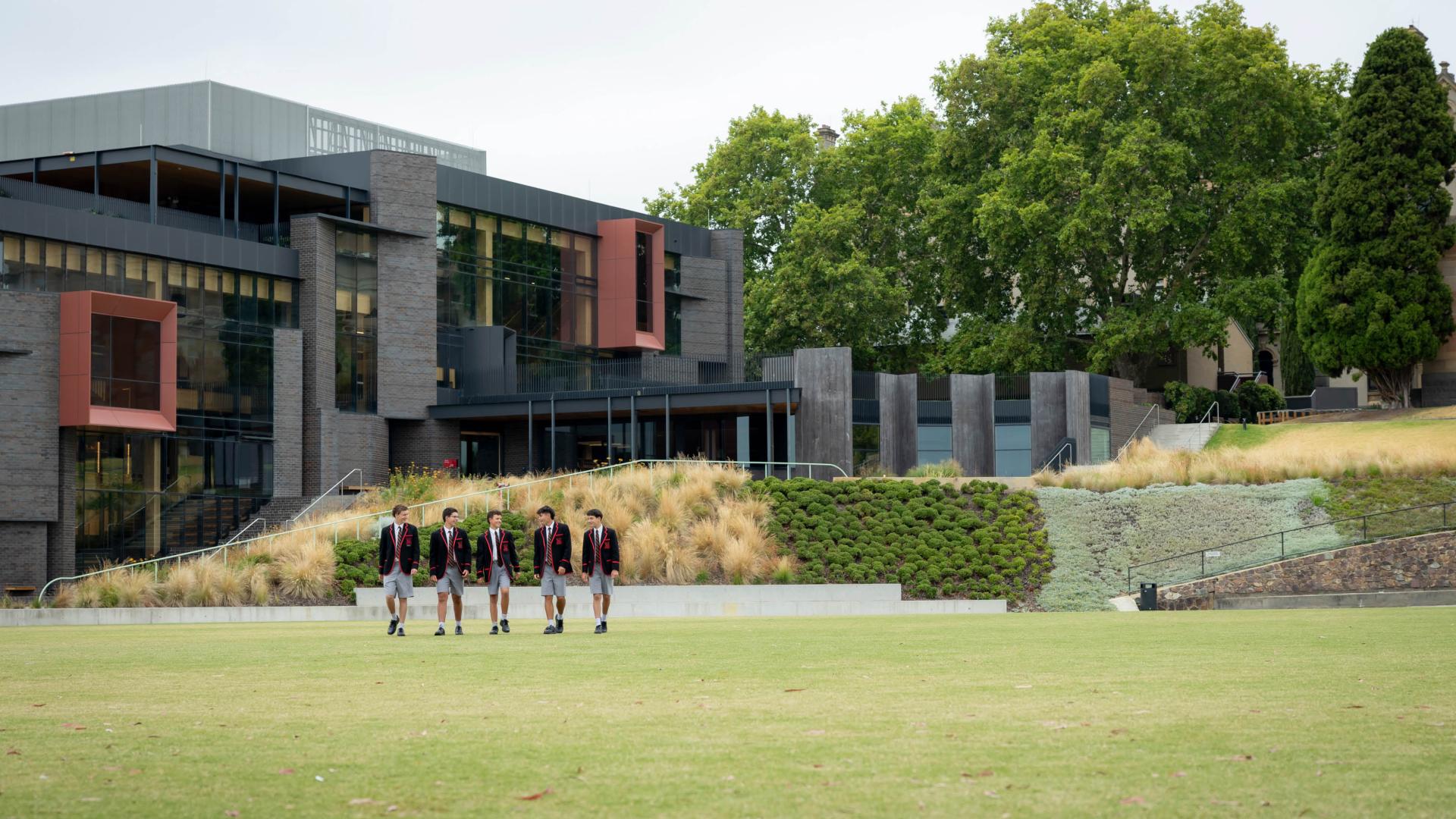
Insights from the Principal: In this three-part series, Principal Lee MacMaster reflects on the value of boys’ education and how a school designed specifically for boys can help them learn, grow and flourish.
Recently, I have been asked two important questions by prospective parents considering Xavier College for their son.
They are, in many respects, simple questions. Yet they are also deeply important questions for any parent seeking to make one of the most significant decisions they will make on behalf of their child:
Why is a boys’ education at Xavier College a better option than attendance at a co-educational school?
What can Xavier College offer my son that other similar schools cannot?
After my first six months as Principal of Xavier College and drawing upon my previous experience in leadership in boys’ (and coeducational) schools in New South Wales and Queensland, I have reflected carefully on these questions. My answers are both straightforward and, inevitably, somewhat complex.
I would never suggest that a boys’ school is automatically a better school than a co-educational school. The quality of teaching, the character of the school, the quality of relationships, the opportunities provided to students and the values that underpin the education are all enormously important.
But I do hold a strong view: when a boys’ school understands boys, believes in boys and deliberately creates an environment in which boys can flourish, there are profound educational advantages.
And I believe Xavier is such a school.
Why educate boys in a boys’ school?
The first advantage is that a boys’ school can place boys at the very centre of its educational thinking.
This does not mean stereotyping boys or suggesting that every boy learns in the same way. Quite the opposite. Boys are individuals, with extraordinary diversity in personality, temperament, interests, capacity and ways of engaging with the world.
What a strong boys’ school can do is create an environment in which teachers are deeply attuned to the developmental needs of boys and can design learning, relationships and experiences accordingly.
The research in this area is nuanced. There is no credible basis for claiming that simply separating boys and girls automatically produces superior academic outcomes. The evidence is much more complicated than that. However, researchers such as Michael Reichert and Richard Hawley, through their international study of effective teaching practices for boys, have identified the importance of relationships, engagement, relevance and teaching practices that connect with the ways boys experience learning.
More recently, Leonard Sax, reflecting on 25 years of work in boys’ education, has argued that the real value of a boys’ school lies in the opportunity to educate differently. His important qualification is that simply putting boys together is not enough: teachers need to understand how to teach boys well and schools need to deliberately create the conditions in which boys can thrive.
That distinction matters enormously.
A boys’ school at its best is not simply a school without girls. It is a school deliberately designed around the flourishing of boys. I have seen this repeatedly throughout my career.
Boys can thrive in classrooms where intellectual curiosity is encouraged, where there is permission to ask difficult questions, where humour and energy can be harnessed positively, where competition can be healthy, where teachers know when to challenge and when to encourage, and where boys are not afraid to take intellectual risks.
I have also seen the remarkable friendships that develop in boys’ schools.
There is something powerful about the brotherhood that can emerge when boys learn, compete, perform, serve, travel, struggle and celebrate together. The relationships formed during these years can become enduring relationships for life.
And importantly, boys’ schools can provide opportunities for young men to develop relationships with adults who know them well.
At Xavier, we talk often about cura personalis — care for the whole person. This means that a boy is never simply a student, a VCE result, an ATAR, a sporting statistic or a name on a class list.
He is a person.
He needs to be known.
He needs to be challenged.
He needs to be encouraged.
He needs to be held accountable.
And, sometimes, he simply needs an adult to notice that something is not quite right.
That is one of the great strengths of a boys’ school when it is done well.